
If you’re investing in a Brazilian Butt Lift, you deserve a straight answer about how long the results will hold up.
How long do BBL results last is one of the most searched questions among women considering this procedure, and the honest answer is this: with proper care, BBL results typically last between 5 and 10+ years, and the surviving fat is considered permanent after the 6-month mark.
Survival rates are highly variable based on individual factors and the surgical technique itself, but the science behind fat retention is well documented.
Below, you’ll find a realistic breakdown of what to expect, what affects longevity, and lifestyle play a role almost no other article covers.
What is a BBL?
A Brazilian Butt Lift (BBL), medically known as gluteal fat transfer, is a body contouring procedure that uses your own fat to enhance the shape and projection of the buttocks. It is not an implant procedure and not a skin lift — no foreign material is placed, and sagging skin is not removed.
The procedure has three phases: liposuction from donor areas (usually abdomen, flanks, or thighs), purification of the harvested fat, and re-injection into the gluteal region.
According to the American Society of Plastic Surgeons, gluteal fat grafting is one of the most popular cosmetic procedures performed in the U.S., and refined techniques have made it significantly safer over the past decade.
How long do BBL results actually last?
BBL results last between 5 and 10+ years for most patients, with many enjoying their enhanced contours for over a decade when weight stays stable. Approximately 60-80% of transferred fat survives long-term, with final results visible at 6 months post-surgery.
The fat that survives this critical window establishes its own blood supply and behaves like any other fat cell in your body — meaning it’s there to stay, as long as you maintain a healthy lifestyle.
The reason results aren’t strictly “permanent” in the cosmetic sense is biological: aging, weight fluctuations, and skin elasticity changes will gradually shift the appearance over time. Based on clinical follow-up data, patients who maintain a stable weight (within 10 lb of their post-op weight) frequently keep over 90% of their initial results past the 5-year mark.
⚠️ Important scope note These timelines apply to BBLs performed by board-certified plastic surgeons using the current subcutaneous-only injection technique. Mortality rates are approximately 1 in 14,952 with subcutaneous-only fat injection techniques, comparable to other major cosmetic procedures, a major improvement over older intramuscular approaches. Always verify your surgeon’s board certification and facility accreditation before scheduling.
BBL results timeline: what happens month by month
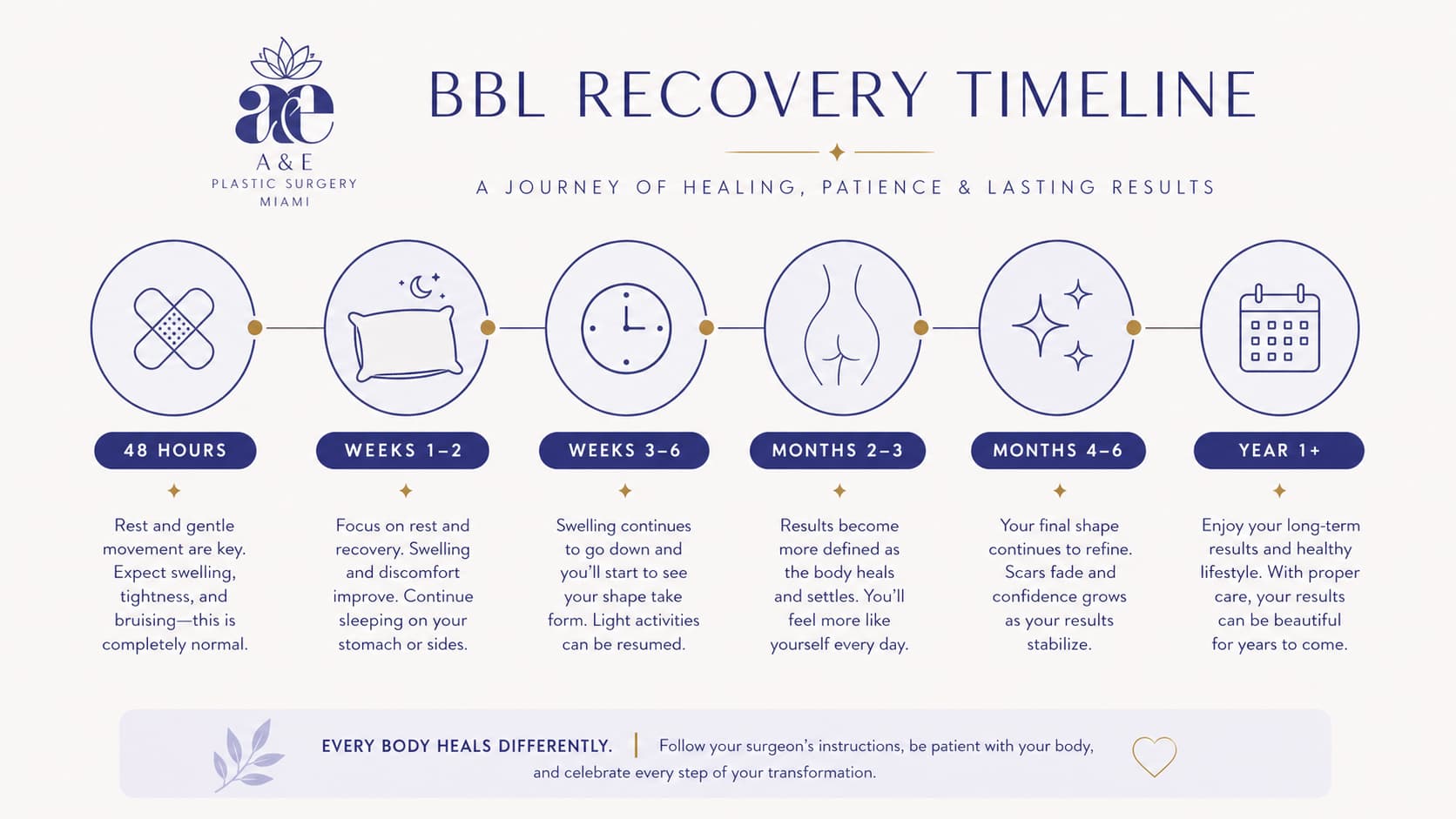
Recovery isn’t linear, and understanding what’s normal at each stage prevents unnecessary panic. Here’s what to expect:
- First 48 hours — Manage peak swelling: Inflammation reaches its maximum. The buttocks look fuller than they will be. Avoiding pressure during this window protects the initial vascular connection.
- Weeks 1–2 — Protect the graft: No direct sitting on the buttocks. Use a BBL pillow when sitting is unavoidable. Compression during this period kills fat cells that haven’t yet developed blood supply.
- Weeks 3–6 — Critical fat survival window: Swelling decreases, donor areas may still feel tender. This is when transferred fat establishes permanent vascularization.
- Months 2–3 — The shrinking phase (don’t panic): The buttocks may look flatter than expected. This is the body reabsorbing non-viable fat. This is normal and expected — not a sign that the procedure failed.
- Months 4–6 — The fluffing phase. Tissues soften, the buttocks round out, and final shape emerges. This is your real result.
- Year 1 and beyond — Stabilized: Surviving fat behaves like native tissue and responds to your weight and lifestyle.
What is BBL fluffing?
Fluffing is the colloquial term for the period (usually months 2–6) when the buttocks transition from looking compressed and slightly flat to soft, rounded, and naturally projected. It’s a real phenomenon tied to swelling resolution and tissue settling — not a marketing term.
What affects BBL longevity
Some factors are within your power, others aren’t. Knowing the difference helps you focus your energy where it actually matters.
Factors you control:
- Weight stability: Fluctuations greater than 10 lb directly change buttock volume since transferred fat behaves like native fat.
- Smoking: Nicotine constricts blood vessels and reduces oxygen delivery, severely compromising fat survival. Surgeons typically require quitting at least 4 weeks before and after surgery.
- Hydration and protein intake: Tissue regeneration depends on both. Aim for at least 2 liters of water daily and a protein-rich diet during healing.
- Compliance with post-op protocol: Compression garments, sleep position, and the BBL pillow aren’t suggestions — they directly affect graft retention.
- Professional lymphatic drainage: A clinical post-op protocol (not a spa treatment) reduces fibrosis in donor areas and supports the healing process.
Factors you don’t control:
- Skin elasticity (declines with age)
- Genetics and metabolism
- Available donor fat at the time of surgery
- Your tissue’s individual capacity to revascularize the graft
A really talented and experienced surgeon obviously maximizes the chances of fat survival — which is why technique and surgeon experience are arguably the most decisive variable of all, and the only one you control by choosing where you have your procedure done.
BBL vs Liquid BBL vs implants: which lasts longer?
Different procedures, different durations. Here’s how they compare on the criteria that actually matter:
| Criteria | Traditional BBL | Liquid BBL (Sculptra/HA) | Butt Implants |
| Average duration | 5–10+ years | 2–3 years | 10–20 years |
| Material | Your own fat | Hyaluronic acid or Sculptra | Silicone prosthesis |
| Recovery time | 6–8 weeks | None to minimal | 6–8 weeks |
| Volume gain | High | Low to moderate | Very high |
| Natural feel | Yes | Yes | Less natural |
| Revision frequency | Optional, 6–12 months | Every 1–2 years | Every 10–15 years |
| Main risk | Fat reabsorption | Temporary, needs touch-ups | Capsular contracture, displacement |
Traditional BBL suits patients with enough donor fat who want a natural, long-lasting result. Liquid BBL fits those wanting modest enhancement with no downtime, accepting shorter duration. Implants make sense for very thin patients without sufficient donor fat who want maximum, predictable volume despite higher long-term risks.
Why patients in Miami choose A&E Plastic Surgery
When you’re choosing where to have a procedure with 10+ years of impact, the details matter. Here’s what sets A&E Plastic Surgery apart:
- Board-certified plastic surgeons with credentials from the American Board of Plastic Surgery and active membership in the ASPS — the gold standard for safety and ethics.
- Bilingual care team (English and Spanish) so consultations, pre-op instructions, and recovery follow-up happen in the language you actually think and feel in.
- Lymphatic drainage as a clinical protocol, not an optional add-on, integrated into every BBL recovery plan to reduce fibrosis and support fat retention.
- Structured 12-month follow-up with scheduled checkpoints rather than one-time post-ops, so we monitor your healing and longevity outcomes as they evolve.
- Located in Miami and tailored to the climate, culture, and lifestyle our patients actually live.
- Financing and financial planning support so a long-lasting result is also a financially sustainable decision.
A long-lasting BBL is the result of three things working together: a skilled surgical team, a recovery plan adapted to your real life, and your commitment to maintenance. We can deliver the first two — and we’ll guide you through the third.
Ready to talk about whether a BBL is right for you? Schedule a consultation with our team and get a realistic, personalized assessment of your candidacy, expected longevity, and recovery plan.