

If you’ve been searching for abdominoplasty in Miami, chances are you’re past the “should I do this” stage and into the harder questions: will it hurt, how long until I look like myself again, and what could go wrong. That’s a healthy place to be. A tummy tuck reshapes how your body looks and moves, and wanting real answers before you commit is exactly the right instinct.
Abdominoplasty, commonly called a tummy tuck, is a surgical procedure that removes excess skin and fat from the abdomen and tightens the underlying muscles to create a flatter, firmer contour. It is not a weight-loss procedure and it does not replace diet or exercise; it addresses skin laxity and muscle separation that diet and exercise alone cannot fix, most often after pregnancy or significant weight loss according to the American Society of Plastic Surgeons.
This guide walks through who qualifies, what the procedure actually involves, the real risks, a week-by-week recovery timeline, when results settle in, and what it costs in Miami.
Who is a good candidate for abdominoplasty
Not everyone with abdominal laxity needs the same procedure, and matching your body to the right approach matters more than the marketing language clinics use.
Before booking a consultation, run through this quick checklist:
- Your weight has been stable for at least six months: Significant weight fluctuation after surgery can undo the contour.
- You’re not planning future pregnancies: Pregnancy after a tummy tuck can stretch the repaired muscles again.
- You don’t smoke, or you’re willing to stop well before and after surgery: Nicotine restricts blood flow and slows healing.
- You have realistic expectations about scarring: A horizontal scar along the lower abdomen is part of the trade-off for a flatter contour.
- You’re in general good health, without uncontrolled diabetes, clotting disorders, or other conditions that raise surgical risk.
Many candidates come to this decision after pregnancy, after major weight loss, or simply after years of exercise that hasn’t resolved loose skin or a separated abdominal wall (diastasis recti). If pregnancy is still part of your plans, it’s worth reading about pregnancy after a mommy makeover before scheduling anything, since the timing of abdominal surgery relative to future children changes the conversation significantly.
Types of abdominoplasty: which one fits your body
Abdominoplasty isn’t a single fixed procedure. The right version depends on how much skin laxity and muscle separation you have, and how much of the abdomen needs to be addressed.
| Type | Best for | Incision | Typical recovery | Expected result |
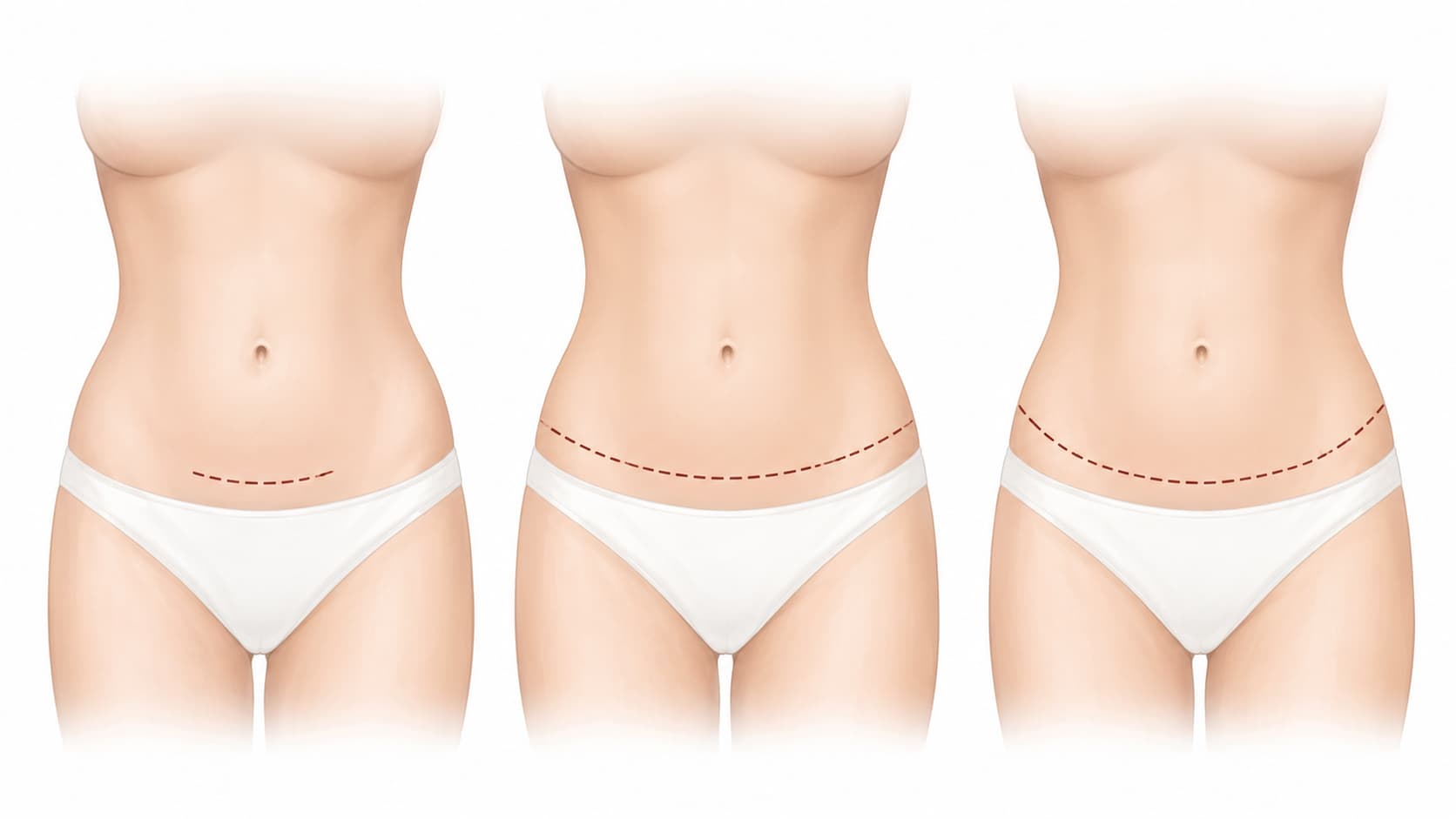
| Mini abdominoplasty | Mild lower-belly laxity, minimal muscle separation | Shorter, below the bikini line | 1 to 2 weeks | Flatter lower abdomen, no navel relocation |
| Full abdominoplasty | Moderate to significant laxity and muscle separation | Hip-to-hip, lower abdomen | 2 to 4 weeks | Flat, tightened abdomen with navel repositioning |
| Extended (circumferential) abdominoplasty | Significant skin laxity extending to the flanks and back, often after major weight loss | Extends around the torso | 4 to 6 weeks | Full torso contouring, addresses back rolls |
A board-certified plastic surgeon should determine which category fits your anatomy during an in-person evaluation. Choosing based on cost alone, without an exam, is one of the more common regrets patients describe after researching options outside a proper consultation.
Risks of abdominoplasty
This section is informational and does not replace a medical consultation. Abdominoplasty is a major surgical procedure performed under general anesthesia, and like any surgery, it carries real risks that a consultation should walk through in detail.
- Infection: Any incision carries infection risk; following wound care instructions exactly reduces this significantly.
- Seroma (fluid buildup): Fluid can collect under the skin after surgery; drains and compression garments are used specifically to prevent this.
- Blood clots (DVT): Abdominal surgery and limited mobility afterward raise clotting risk, which is why early, gentle walking is recommended during recovery.
- Scarring and asymmetry: Healing varies by patient; scar position and final symmetry depend heavily on surgical technique and skin quality.
- Anesthesia complications: General anesthesia carries inherent risk, which is why anesthesiologist qualifications and pre-operative screening matter as much as the surgeon’s skill.
This is exactly where surgeon credentials stop being a formality. Dr. David Gerth is triple board-certified by the American Board of Plastic Surgery (ABPS), the certifying body that requires extensive accredited training, written and oral examinations, and ongoing peer review according to the American Board of Plastic Surgery. That certification doesn’t eliminate risk, but it does mean the surgeon has been formally evaluated on exactly the judgment calls that determine whether a complication is caught early or missed.
Recovery from abdominoplasty
Recovery timelines vary by patient and by which type of abdominoplasty was performed, but most people follow a recognizable pattern.
- Week 1 – Expect swelling, bruising, and a hunched walking posture as the tightened muscles adjust. Drains are typically still in place, and most patients need help with daily tasks.
- Weeks 2-3 – Drains usually come out, mobility improves, and most patients can return to light desk work, though heavy lifting and core exercise remain off-limits.
- Weeks 4-6 – Swelling continues to recede and most patients can resume low-impact exercise with their surgeon’s clearance. The compression garment is typically still worn during this window.
- Month 3 and beyond – Residual swelling settles further and the abdominal contour becomes noticeably more defined month over month.
One factor that consistently shows up in how comfortable this window feels: manual lymphatic drainage (MLD). This is a gentle, technique-specific massage that helps move post-surgical fluid out of swollen tissue, and it’s a standard part of recovery culture in Brazil, where it’s frequently coordinated alongside body contouring procedures. At A&E Plastic Surgery, MLD is built into the recovery protocol rather than offered as an upsell, which patients often describe as making the swelling and discomfort of weeks 1-3 noticeably more manageable.
👉 For more detail on how this works, see our guide to lymphatic drainage after surgery.
Results of abdominoplasty
It’s normal to look at your abdomen two weeks out, see swelling, and wonder if the surgery worked. It did, you’re just not seeing it yet. Swelling commonly persists in some form for three to six months, and the final, settled contour is typically visible between six and twelve months after surgery according to plastic surgery recovery research published by Cleveland Clinic.
Results are generally long-lasting as long as weight stays stable, since the skin and fat removed during surgery does not return, though the muscle tightening can be affected by future pregnancy.
How much does abdominoplasty cost in Miami
Cost is one of the most searched questions around this procedure, and clinics that avoid the topic entirely aren’t doing patients any favors. While the exact price depends on the type of abdominoplasty, anesthesia, and facility fees, an all-inclusive quote should account for:
- Surgeon’s fee
- Anesthesia and anesthesiologist fee
- Operating facility fee
- Post-operative garments and follow-up visits
- Lymphatic drainage sessions, if included in the package
A&E Plastic Surgery provides transparent, all-inclusive pricing rather than a base number that grows once anesthesia and facility fees are added separately.
For patients who need to spread the cost over time, financing is available through CareCredit, Alphaeon Credit, and Affirm.
Read more:
👉 Plastic surgery cost in Miami: Complete guide to prices
Why choose A&E Plastic Surgery for your abdominoplasty in Miami
Choosing a surgeon for abdominoplasty is a decision about trust as much as technique, and a handful of concrete factors should guide it more than marketing claims.
Board-certified expertise you can verify. Dr. David Gerth is triple board-certified by the ABPS, Dr. Kayne Willis and Dr. Sebastian Gutierrez bring additional board-certified expertise to the team, and that certification is a credential families can check independently rather than take on faith.
Bilingual care, start to finish. Every consultation, pre-operative discussion, and recovery check-in happens in English or Spanish, whichever you’re most comfortable in. For Miami’s Latina community, that means nothing about your goals or your concerns gets lost between you and your surgeon.
Lymphatic drainage included, not upsold. Brazilian-style MLD is part of the standard recovery protocol after abdominoplasty at A&E, addressing one of the most common complaints patients have about swelling and discomfort during weeks 1-3.
Transparent, all-inclusive pricing. Surgeon’s fee, anesthesia, facility costs, and follow-up care are quoted together from the start, with CareCredit, Alphaeon Credit, and Affirm available to finance the total responsibly.
If you’re ready to find out which type of abdominoplasty fits your body, A&E Plastic Surgery offers consultations in Miami in both English and Spanish to walk through your anatomy, your goals, and a transparent quote before you decide anything.
Frequently asked questions about abdominoplasty in Miami
Most patients describe tightness and soreness rather than sharp pain, especially with proper pain management; the first few days are typically the most uncomfortable.
Yes, but pregnancy can stretch the repaired abdominal muscles again, so most surgeons recommend completing your family before this procedure.
Liposuction removes fat but doesn’t address loose skin or muscle separation; abdominoplasty does both, which is why the two are often combined.
It removes stretch marks located on the skin that’s surgically excised, typically below the navel, but it won’t eliminate marks above that area.